
5 Signs Your Tamarac Concrete Needs Repair Now
Most concrete repair jobs in Tamarac cost between $500 and $2,500 — but homeowners who wait until June to address damage that appeared in March routinely turn a $600 repair into a $6,000 structural overhaul, because Broward County’s rainy season fills every open crack with water and accelerates subgrade erosion faster than most of the country experiences. Knowing the specific warning signs that indicate repair is needed — and which ones require urgent attention before the wet season — is worth the read. In this post, we cover the 5 concrete warning signs Tamarac homeowners should know, what each sign indicates, and when to act.
Concrete Repair in Tamarac — Free Assessment
Tamarac Concrete Pros assesses damage and provides repair estimates — call (888) 376-0955.
Why Concrete Damage Escalates Faster in Tamarac
Concrete damage in South Florida operates on a faster clock than in most of the US. The mechanism is straightforward: Broward County’s rainy season delivers 62 inches of rainfall annually, concentrated in June through September. Any crack, joint failure, or drainage issue that exists when June arrives gets four months of water infiltration. Water that enters a crack migrates to the sandy subgrade beneath the slab, begins washing away the support material, and eventually creates a void — a section of concrete that is no longer supported from below. Once that void forms, the slab begins to settle or crack structurally, and the repair scope jumps from surface work to structural replacement.
The compounding factor is Tamarac’s high water table in lower-lying areas, particularly near the Mainlands of Tamarac Lakes and along canal-adjacent streets. In these areas, subgrade saturation occurs faster and the drainage recovery between storms is slower — meaning a crack that might cause minor subgrade erosion in an interior neighborhood causes major erosion near the water. Address these signs quickly in any Tamarac location, but especially in low-lying areas.
Sign 1: Cracks Wider Than 1/4 Inch
Surface cracks under 1/4 inch wide are normal and generally indicate controlled joint cracking — the concrete is doing exactly what it was designed to do. When cracks exceed 1/4 inch, the joint has exceeded its design capacity, meaning either the underlying subgrade has shifted or the concrete slab has moved. Cracks wider than 1/4 inch allow water to penetrate freely to the subgrade, bypassing the surface seal entirely. Once rainfall reaches the sandy soil beneath the slab, erosion begins with the next heavy rain.
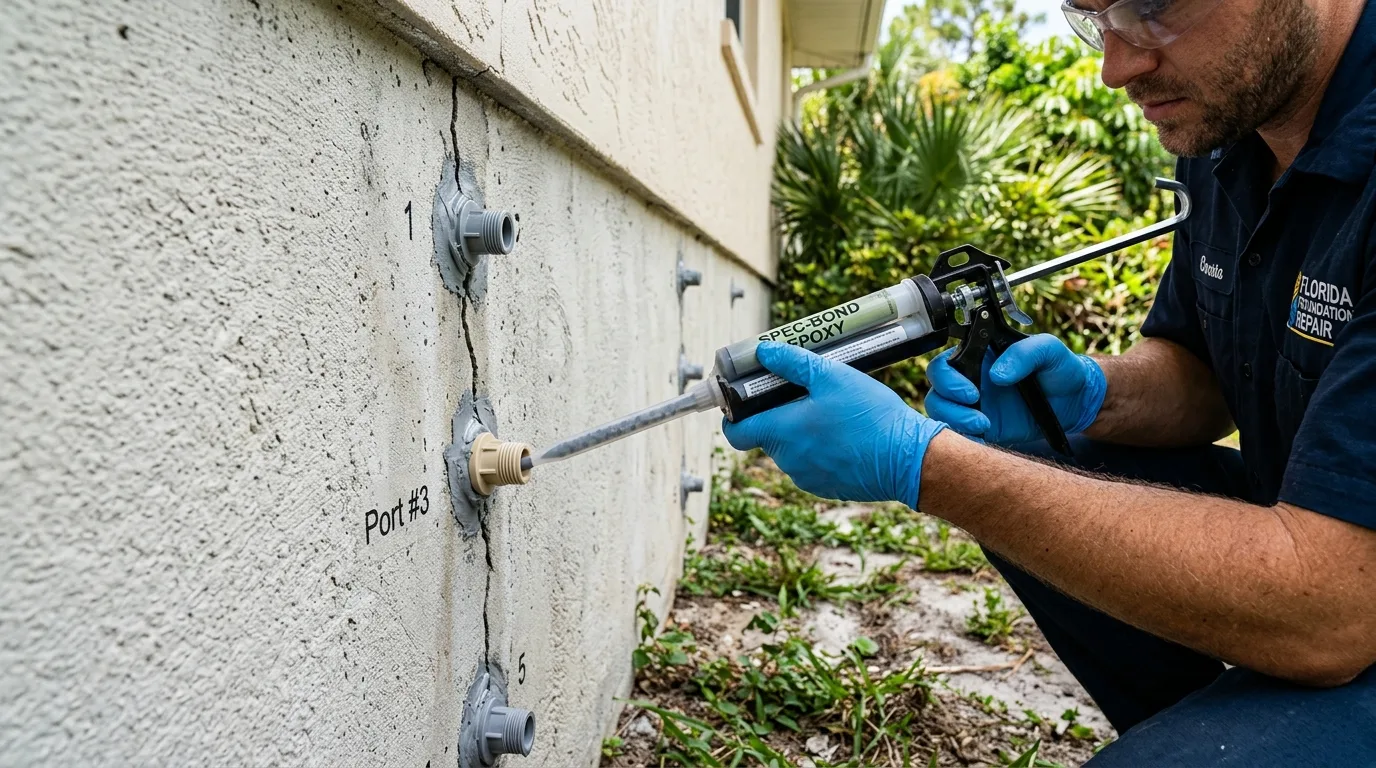
What to do: Repair cracks over 1/4 inch with a structural epoxy injection or polyurethane foam filler before the rainy season. Surface crack fillers are not adequate for cracks this wide — the repair material must be rigid enough to prevent the crack from opening further during the next thermal expansion cycle.
Sign 2: Sections That Feel Hollow When You Walk or Tap
Solid concrete sounds and feels firm underfoot. A section that sounds hollow when tapped with a hammer — or flexes slightly when you walk across it — has a void beneath it. Sandy soil under Tamarac driveways is particularly susceptible to erosion from water infiltration, and voids form faster than homeowners expect. A void that is 6 inches in diameter in March may be 24 inches in diameter by September after four months of rainy season infiltration.
What to do: Mudjacking (pressure injection of a grout mixture beneath the slab to fill voids and re-level the section) addresses this problem before the void causes visible slab settlement. Mudjacking costs $500–$1,500 per section in Tamarac. Waiting until visible settlement occurs often requires slab removal and replacement at $8–$12 per square foot.
Sign 3: Water Pooling on the Concrete Surface
Concrete driveways and patios must slope at least 1/4 inch per foot away from structures to drain properly. When water pools on the surface instead of draining, it either means the slope has changed (indicating subgrade settlement) or the drainage gradient was inadequate from initial installation. In Tamarac’s context, standing water on a driveway during a rainstorm is particularly concerning — it means the concrete is unable to direct the water load away from the slab edges, which then flows along the slab perimeter and infiltrates the subgrade from the sides.
What to do: Small settlement-related drainage changes can sometimes be addressed with a thin concrete overlay that re-establishes proper slope. Significant settlement typically requires slab removal and reinstallation with corrected grade.
Don't Wait Until Rainy Season to Repair
Call Tamarac Concrete Pros at (888) 376-0955. We assess damage and book repairs before Broward's wet season.
Sign 4: Surface Spalling or Flaking
Spalling describes the flaking and pitting of the concrete surface layer — the finished top 1/4 to 1/2 inch peeling away from the slab below. In Tamarac, surface spalling is typically caused by one of two factors: applying a concrete sealer too soon after the pour (before the concrete fully cured, which traps moisture and causes the surface to delaminate), or using a sealer product not rated for South Florida’s UV intensity, which breaks down and allows moisture infiltration that then causes freeze-thaw damage in rare cold snaps or just moisture cycling under the surface layer.
Unlike structural cracks, spalling is primarily a cosmetic and maintenance issue in its early stages. However, if the underlying concrete is exposed and unsealed during the rainy season, UV and moisture combine to accelerate the spalling across larger surface areas. A small 2-foot spalled patch in spring can become a 10-foot problem by fall.
What to do: Early-stage spalling (patches under 1 square foot) can be addressed with resurfacing compound. Widespread spalling indicates a full resurfacing overlay is needed — $4–$6 per square foot in Tamarac for a professionally applied overlay.
Sign 5: Cracks at or Near Expansion Joints That Are Growing
Control joints are designed to be where cracks occur — that’s the point. But cracks that begin at a control joint and extend outward past it, or that appear to grow wider between seasonal inspections, indicate the joint is no longer controlling the movement adequately. This typically means the subgrade beneath the slab is actively shifting — sandy soils in Broward County can shift when large trees are removed, when nearby excavation occurs, or simply after years of wet-dry seasonal cycles.
When joint cracks are actively growing, the underlying cause is movement — and movement means the slab is not fully supported. Adding crack filler without addressing the subgrade condition will fail: the same movement that opened the crack will reopen the filled repair. The repair scope here is subgrade stabilization first, then crack repair.
Cost Factors
Concrete repair costs in Tamarac range from $150–$400 for isolated crack filling to $500–$1,500 for mudjacking to $4–$8 per square foot for full resurfacing. The cost driver that separates routine repairs from major structural repairs is always subgrade condition — repairs that address only the visible surface while leaving a compromised subgrade will fail and require the same repair (at higher cost) within two to three years. See our concrete repair services page for specific pricing by repair type.
Frequently Asked Questions
What’s the difference between a crack that needs repair and a normal concrete crack?
Cracks under 1/4 inch wide at control joints are normal and expected — concrete expands and contracts with temperature, and control joints guide cracks to predetermined locations. Cracks wider than 1/4 inch, cracks that extend past control joints, cracks accompanied by settlement or hollow-sounding sections, and cracks that are visibly growing between seasonal inspections all require professional attention. When in doubt, have a Tamarac concrete contractor assess whether the crack is active (still moving) or stable.
How urgently should I repair concrete damage in Tamarac before the rainy season?
If damage is visible by April or May, schedule repair for completion before June. Broward County’s rainy season begins in earnest in June, and four months of water infiltration through an open crack or joint failure can turn a $500 repair into a $5,000+ structural problem by October. The scheduling lead time for reputable concrete contractors in Tamarac during spring is typically three to six weeks — start the repair process in March or April.
When does concrete damage in Tamarac mean full replacement?
Replacement is appropriate when structural damage is widespread through the full slab depth, multiple sections have settled significantly, drainage failure is causing ongoing subgrade erosion across the full driveway or patio area, or the concrete is more than 25–30 years old with extensive deterioration. Our driveway maintenance guide covers the repair-vs.-replace decision framework in detail.
Fix Concrete Damage Before Rainy Season
Call Tamarac Concrete Pros at (888) 376-0955 for a free damage assessment and repair estimate in Tamarac.
Related: